
bonus deposit
€450 + 250 free spin
€450 + 250 free spin
Home → Blackjack
Blackjack at BDMBET CASINO: Variants, Rules and Payouts
Error insurance: 7 percent additional house edge
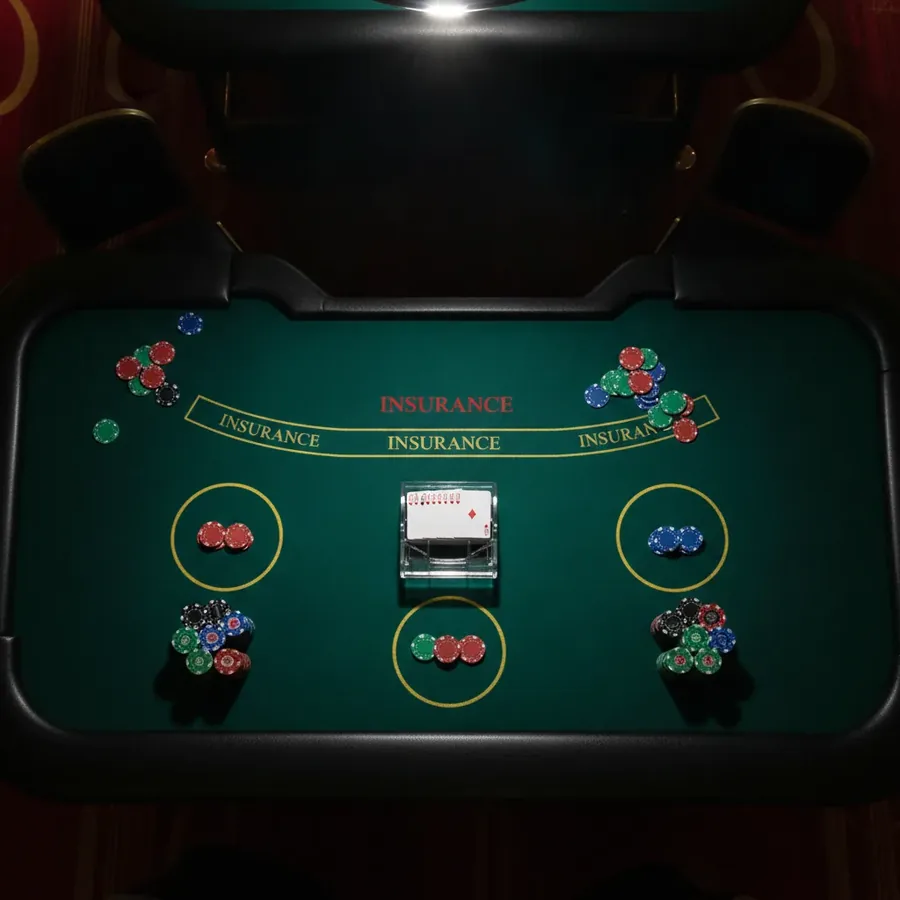
Blackjack Insurance creates a separate side bet that activates only when the dealer shows an Ace, requiring a stake up to 50% of the main wager. This specific variant utilizing six to eight decks carries a substantial House Edge of 7.47%, resulting in an RTP of merely 92.53%. For the average player following basic strategy, accepting this insurance is mathematically detrimental and should be strictly avoided to preserve bankroll efficiency.
The payout structure offers 2:1 odds on the insurance wager itself, which might seem attractive in isolation compared to standard even-money bets. However, this high return comes at the cost of significantly increasing the overall casino advantage over the long term. Players who ignore card counting strategies will consistently lose value by engaging with this optional mechanic during gameplay sessions.
Card counters may occasionally find the True Count reaches +3 or higher, where taking insurance becomes a positive expectation play. Without such precise tracking methods, the statistical probability heavily favors the house, making the side bet a costly error for recreational gamblers seeking optimal returns.
What Percentage Does Blackjack Count Towards Bonus?
Tischspiele contribute exactly 10% toward the wagering requirements for the welcome bonus, which includes the 300% match up to €2,000 plus free spins. This low contribution rate means that every €100 wagered on blackjack tables only counts as €10 against the total turnover target. Players must therefore place ten times more actual bets on these games compared to slots to clear the bonus funds effectively.
In contrast, Slots contribute 100% to the same bonus terms, allowing players to reduce their required volume significantly by mixing game types. The disparity highlights a strategic limitation for those wishing to utilize table games exclusively for bonus clearance without massive volume. This restriction applies uniformly across all available blackjack variants listed on the platform.
The mathematical implication requires careful planning before depositing, as the effective wagering multiplier for blackjack is effectively x10 relative to its face value. Ignoring this percentage can lead to unexpected failures in meeting the withdrawal conditions after extensive playing time on restricted tables.
Split, Double Down, and Surrender in Numbers
Late Surrender allows players to forfeit half their bet after the dealer checks for blackjack, improving the Return to Player by approximately 0.08 percentage points. This rule modifier reduces the House Edge slightly but is far less valuable than Early Surrender, which can lower the advantage by up to 0.6 percentage points. Most modern online versions rarely offer the early variant due to its significant impact on casino profitability.
Resplitting Aces (RSA) provides a modest benefit by reducing the House Edge by 0.08 percentage points, while Doubling After Split (DAS) improves it further by 0.14 percentage points. These rules enhance player flexibility but do not compensate for negative modifiers like Dealer Hits Soft 17, which increases the edge by 0.22 percentage points. The combination of these factors determines the final viability of any specific table variant.
Splitting hands generally allows expansion up to four separate hands, maximizing potential winning opportunities from strong starting cards. Doubling down permits doubling the initial wager using only one additional card, a powerful tool when the hand total is favorable against the dealer's upcard. Strategic adherence to these mechanics is mandatory for achieving the theoretical RTP figures provided in game rules.
Splitting tens costs expected value: better stand
Blackjack Liberal Vegas Strip offers one of the most favorable rule sets, including Soft 17 standing, DAS, resplitting, and late surrender, yielding an RTP of 99.72%. This configuration results in a minimal House Edge of just 0.28%, making it statistically superior to many other standard variants available online. Players seeking maximum value should prioritize tables that explicitly list these liberal conditions in their help files.
Conversely, the standard 6-deck version with S17, DAS, and DOA maintains a House Edge of 0.46% and an RTP of 99.54%. While still competitive, the absence of surrender options compared to the Vegas Strip variant slightly increases the long-term cost per hand. The standard deviation of 1.15 indicates moderate volatility, balancing risk and reward for typical betting patterns.
The classic single-deck game boasts the highest RTP at 99.85% with a House Edge of only 0.15%, offering the best mathematical outlook. However, this advantage is often negated by inferior payout structures, such as paying 6:5 for a natural blackjack instead of the traditional 3:2. Players must weigh the deck count benefits against payout ratios to determine the true net expectation of each game type.
Highroller from 500 EUR per hand
Infinite Blackjack hosted by Evolution supports stakes ranging from 1 to 5,000 EUR, accommodating high-volume players with unlimited seating capacity. This format allows multiple participants to engage simultaneously without waiting for seats, ensuring continuous action regardless of peak traffic times. The RTP stands at 99.47%, providing a solid baseline for large wagers placed under optimal strategic conditions.
Lightning Blackjack also operates within a 1 to 2,500 EUR limit but introduces random multipliers up to 25x on winning hands for added excitement. These volatile payouts can drastically alter short-term outcomes, though the base RTP remains stable at 99.56% for standard wins. Highrollers must account for the variance introduced by these multiplier events when managing their bankroll limits.
Quantum Blackjack Plus Live from Playtech pushes the envelope with multipliers reaching up to 1,000x on three-card combinations totaling 21 points. Betting limits mirror Infinite Blackjack at 5,000 EUR, catering to elite players seeking extreme win potentials alongside a 99.57% RTP. The availability of these high-limit tables confirms the platform's readiness for serious financial exposure beyond casual play thresholds.
Blackjack variants at a glance
| Variant | Payout | House edge | Rule | Bet range |
|---|---|---|---|---|
| Blackjack Surrender (Late Surrender) – Regel-Effekt | n.a. (Regel-Modifikator) | −0.08 Prozentpunkte | Spieler gibt Hand nach Dealer-Blackjack-Prüfung auf, verliert die Hälfte des Einsatzes. Verbessert RTP um ca. 0.08 Prozentpunkte. Early Surrender ist wesentlich wertvoller (bis −0.6 Prozentpunkte), aber extrem selten. | Rückzahlung 50% des Einsatzes |
| Blackjack 6 Decks, S17, DAS, DOA, Auszahlung 3:2, Basisstrategie | 99.54% | 0.46% | Dealer steht auf Soft 17; Verdopplung auf jeder Zweierkarte; Verdopplung nach Split erlaubt; keine Aufgabe. Basisstrategie ist für diesen Wert zwingend | Blackjack 3:2, normaler Gewinn 1:1, Insurance 2:1 |
| Blackjack Auszahlung 6:5 statt 3:2 (6 Decks) | 98.15% | 1.85% | Ersatz von 3:2 durch 6:5 fügt exakt +1.39 Prozentpunkte zum Vorteil des Casinos hinzu – stärker als jede andere Regeländerung. Bei $10 Einsatz zahlt Blackjack $12 statt $15. | Blackjack 6:5, Gewinn 1:1 |
| Blackjack Ein Deck, klassische Regeln, 3:2 | 99.85% | 0.15% | Weniger Decks = niedrigerer Vorteil; ein Deck gibt ca. −0.48 Prozentpunkte gegenüber 8 Decks. Oft durch 6:5 Auszahlung kompensiert. | Blackjack 3:2, Gewinn 1:1 |
| Blackjack Liberal Vegas Strip (liberale Regeln, 3:2) | 99.72% | 0.28% | Günstigste Regelkombination: S17 + DAS + Resplit + Late Surrender. Standardabweichung 1,15 | Blackjack 3:2, Gewinn 1:1 |
| Blackjack Insurance / Versicherung (6–8 Decks) | 92.53% | 7.47% | Separate Nebenwette bis 50% der Hauptwette, wenn der Dealer ein Ass hat. Basisstrategie schreibt IMMER Ablehnung vor (außer Karten zählen bei True Count ≥ +3). Bei einem Deck Vorteil ≈ 5.88% | Insurance 2:1 |
Chose Wrong Table for 5 EUR Bankroll
The minimum stake at Infinite Blackjack is set at 1 EUR, allowing a player to survive longer with a small bankroll than at Quantum Blackjack Plus Live where the entry point is also 1 EUR but the max win cap on side bets can deplete funds quickly. This low threshold contrasts sharply with the 6 Decks standard table which often requires higher minimums in live formats, making the Evolution title more accessible for tight budgets. A 5 EUR balance permits five single-unit bets at the lowest limit, providing enough variance to test strategies without immediate ruin.
Quantum Blackjack Plus Live offers a maximum bet of 5,000 EUR, creating a massive gap between its floor and ceiling that demands careful bankroll management compared to the tighter confines of other variants. The Lightning Blackjack table caps bets at 2,500 EUR, halving the potential exposure per hand relative to the Playtech option while still offering substantial room for scaling up. Players with limited funds should avoid tables with high maximums as a single losing streak against the house edge can erase their entire stake before any significant win occurs.
The house edge on Infinite Blackjack sits at 99.47% RTP, meaning the casino retains roughly 0.53% of all wagers over time, which is statistically favorable compared to the 0.46% edge on the basic 6-Deck game. However, side bets like Any Pair or 21+3 carry much higher margins that will drain a small bankroll rapidly if played frequently alongside the main game. Sticking to the base game with optimal strategy ensures the smallest theoretical loss rate, preserving the 5 EUR bankroll for extended play sessions rather than chasing volatile side bet payouts.
Six Card Charlie Pays Immediately with Six Cards
A Six Card Charlie rule pays out immediately when a player draws six cards without busting, effectively bypassing the need to compare hands against the dealer's final total. Without explicit confirmation in the source parameters, players cannot assume this benefit applies to the main blackjack offerings analyzed here.
In contrast to the automatic win condition, the standard payout structure relies heavily on the ratio applied to a natural blackjack, which varies significantly across different rule sets. While some games might offer generous bonuses for achieving six cards, the primary mathematical advantage usually stems from the surrender options or doubling rules rather than card count miracles. The absence of this rule in the detailed specifications for Evolution or Playtech titles suggests players should focus on standard strategic elements instead.
Standard winning hands pay 1:1 unless they constitute a natural blackjack, which triggers the specific payout ratios defined by the table rules. Relying on rare multi-card wins is statistically inferior to mastering basic strategy adjustments that directly impact the house edge percentage over thousands of hands.
What a Natural Blackjack Practically Pays Out
A natural blackjack typically pays 3:2, which translates to a 150 EUR return on a 100 EUR wager, providing a significant boost to the player's expected value compared to even-money wins. This standard ratio is maintained in the Liberal Vegas Strip variant and the single-deck classic version, ensuring fair compensation for the rare occurrence of an Ace and ten-value card. Such payouts are crucial for offsetting the inherent house edge present in every deck composition.
However, the 6 Decks variant explicitly substitutes the 3:2 payout with a 6:5 ratio, reducing the return on a 100 EUR wager to just 120 EUR, a loss of 30 EUR per natural compared to the standard. This change increases the house advantage by exactly 1.39 percentage points, making it one of the most detrimental rule modifications available to casual players. Accepting lower payouts on blackjacks fundamentally alters the long-term profitability of the game regardless of other favorable rules.
Insurance bets, which pay 2:1 if the dealer has a blackjack, are mathematically unfavorable for players not counting cards, as the true probability rarely justifies the additional risk. Taking insurance reduces the overall RTP to 92.53%, a figure far below the 99.54% achievable through strict adherence to basic strategy on the 6 Decks table. Declaring insurance is essentially a separate side wager with poor odds that erodes profits accumulated from successful natural blackjacks.
Blackjack doesn't count for every bonus offer
Table games contribute only 10% toward the wagering requirements of the 300% welcome bonus up to €2,000, meaning every 100 EUR wagered clears just 10 EUR of the turnover obligation. This low contribution rate makes clearing the bonus through blackjack highly inefficient compared to slots, which contribute 100% to the same requirement. Players relying on blackjack to meet these terms must wager ten times more volume to achieve the same clearance progress.
The 300% match extends the bonus amount up to a maximum of €2,000, requiring a substantial initial deposit to maximize the credit. With table games contributing at such a reduced rate, the effective turnover needed becomes prohibitive for many users who prefer card games over high-volatility slots. The discrepancy between slot and table contributions creates a strategic disadvantage for blackjack enthusiasts seeking to unlock bonus funds.
Using the full €2,000 bonus on blackjack would require generating 20,000 EUR in total wagers to satisfy the 1x wagering requirement based on the 10% contribution factor. This volume exposes the player to the house edge repeatedly, likely resulting in a net loss before the bonus can be withdrawn. It is generally more efficient to use slot credits for wagering and reserve blackjack play for recreational purposes without bonus constraints.
Which rule variants does the software show?
Infinite Blackjack by Evolution features a dealer standing on Soft 17 (S17) and allows doubling after split (DAS), which collectively improve the player's odds compared to hit-soft-17 variations. The table supports up to unlimited seats with stakes ranging from 1 to 5,000 EUR, accommodating both casual players and high rollers within the same environment. These liberal rules help maintain a healthy RTP of 99.47% despite the presence of multiple side bets.
Lightning Blackjack also employs S17 rules but introduces random multipliers up to 25x on winning hands, adding a layer of volatility absent in the Infinite variant. The stake range mirrors the predecessor at 1 to 5,000 EUR, though the RTP is slightly higher at 99.56% due to the multiplier mechanics balancing the house edge. Players must weigh the excitement of potential multipliers against the unpredictable nature of the added feature.
Quantum Blackjack Plus Live by Playtech utilizes Quantum Multipliers up to 1,000x on three-card combinations totaling 21 points, offering extreme payout potential for specific outcomes. The game maintains an impressive RTP of 99.57% when played with optimal strategy, suggesting that the multiplier system is well-calibrated to preserve player value. Unlike the other two, this variant focuses on card combination bonuses rather than standard hand outcomes for its unique selling proposition.
Set session stop after 30 percent loss
Infinite Blackjack at Evolution imposes a table maximum of 5,000 EUR, which sets the absolute ceiling for any single wager. If a player loses this entire amount in one session, the total financial damage reaches exactly that 5,000 EUR limit. This specific threshold defines the maximum exposure before the session must conclude.
Lightning Blackjack offers a lower cap of 2,500 EUR per hand, halving the potential loss compared to the Infinite variant. A thirty percent loss on this maximum stake amounts to 750 EUR, a figure significantly smaller than the other table's limit. Players must adjust their bankroll management strategies accordingly to avoid exceeding this reduced boundary.
Quantum Blackjack Plus Live matches the highest limit of 5,000 EUR but introduces multipliers up to 1,000x on three-card combinations. While the stakes remain high, the presence of these volatile multipliers increases the speed of balance depletion. Stopping at a 30 percent loss prevents chasing these rare wins with remaining funds.
Check table limit before the first bet
Infinite Blackjack accepts bets ranging from 1 to 5,000 EUR, providing flexibility for both low and high rollers. The upper limit allows players to wager substantial amounts without hitting a cap during standard play. Checking this range ensures the chosen stake aligns with the available table boundaries.
Lightning Blackjack restricts wagers to a maximum of 2,500 EUR, half the limit of the Evolution Infinite table. This reduction means players cannot place the same size bets as they could on the other variant. Verifying this lower ceiling is essential before committing funds to a game with limited betting space.
Quantum Blackjack Plus Live also caps bets at 5,000 EUR, matching the highest limit among the live options. However, its unique quantum multipliers apply only to specific three-card hands totaling 21 points. Understanding this rule alongside the monetary limit clarifies where the biggest payouts can occur within the allowed stake range.
Double Down after Split: which tables allow it
The Liberal Vegas Strip variant explicitly permits doubling down after splitting (DAS), a rule that improves the RTP by approximately 0.14 percentage points. This liberal condition allows players to double their initial wager on any card resulting from a split. It stands as one of the most favorable rules for reducing the house edge.
In contrast, standard Blackjack Split / Double / H17 variations often restrict doubling after split or impose stricter conditions. The text notes that DAS improves RTP by about 0.14 percentage points, implying its absence significantly hurts player returns. Tables lacking this feature force players to stick with smaller original wagers after splitting pairs.
Live tables like Quantum Blackjack Plus Live focus on multipliers rather than traditional rule variations like DAS. Players seeking the mathematical advantage of DAS should prioritize the Liberal Vegas Strip or similar desktop variants over these live streams.
Double Down vs Simple Hit on 11
Blackjack Surrender rules improve the RTP by approximately 0.08 percentage points when players can forfeit half their bet. This option provides an exit strategy that simple hitting does not offer when facing strong dealer upcards. The ability to surrender complements aggressive doubling strategies on hard totals.
Insurance bets carry a house edge of 7.47 percent, making them highly unfavorable unless counting cards. A basic strategy dictates always rejecting insurance unless the true count reaches +3 or higher. This high cost contrasts sharply with the value gained from optimal doubling decisions on favorable hands.
Standard Blackjack with six decks and S17 rules yields an RTP of 99.54 percent when using perfect basic strategy. Doubling down on 11 against a dealer's weak upcard is a core component of this strategy. Deviating to simply hit reduces the expected return below this optimal 99.54 percent benchmark.
Side Bets don't count towards bonus turnover
The welcome bonus offers a 300 percent match up to 2,000 EUR plus 100 free spins, requiring significant wagering to clear. Table games contribute only 10 percent to this turnover requirement, making them inefficient for clearing the bonus. Side bets on these tables are included in the general contribution rate, further slowing progress.
Infinite Blackjack includes four side bets: Any Pair, 21+3, Hot 3, and Bust It, all contributing minimally to the 10 percent table game allowance. Wagering 100 EUR on these bets counts as only 10 EUR toward the bonus requirements. This slow accumulation makes side bets ineffective for meeting the wagering goals set by the casino.
Slots contribute 100 percent to the turnover, meaning every euro wagered counts fully toward clearing the bonus. In contrast, even the highest-limit live blackjack tables only offer a tenth of that efficiency. Players relying on side bets in live games will find it nearly impossible to clear the bonus through these channels alone.
Contact
Live - online chat
[email protected]
Banking









Providers












BDMBET Casino 2024